How to Calm Anxiety at Night Naturally: A Toolkit for Racing Minds at 2am
When the Lights Go Out and the Worry Switches On
It is somewhere past midnight. The house is quiet, tomorrow is waiting, and your mind has chosen this exact moment to replay every worry it postponed all day. Your heart is louder than it should be, the bed feels like a stage for your thoughts, and the harder you chase sleep, the further it moves.
This guide is the in-the-moment toolkit for that situation: how to calm anxiety at night naturally, with techniques you can use tonight, from the pillow. It is part of our anxiety in daily life resources. If you want the full picture of how anxiety and sleep feed each other, including insomnia, diagnosis and long-term treatment, our comprehensive guide to sleep anxiety covers that ground; this page is about getting you through tonight and the nights after it.
Why Is Anxiety Worse at Night?
Nothing mystical happens after dark. Night simply removes, one by one, the buffers that keep daytime worry manageable.
- The distractions disappear. All day, tasks, people and screens absorb your attention. In a silent bedroom your mind finally has room to surface everything unresolved, and it takes the invitation.
- You are tired. Fatigue weakens the prefrontal perspective-keeping that talks worries down to size. The 2am version of a problem is always bigger than the 10am version of the same problem.
- Stillness turns up the volume on your body. Lying quietly in the dark, you notice your heartbeat, your breathing, a flutter in your chest. For an anxious mind, noticing quickly becomes monitoring, and monitoring becomes alarm.
- Pressure to sleep becomes its own threat. Watching the hours shrink (“if I fall asleep now I still get five hours”) converts the bed into a performance arena, and your threat system responds accordingly.
Understanding this matters because it reframes the problem: your anxiety is not objectively worse at night, it is simply unbuffered. And buffers can be rebuilt, which is what the toolkit below does.
Night-Time Anxiety Symptoms: Three Patterns Worth Telling Apart
Night-time anxiety shows up in the body (a racing or pounding heart, sweating, trembling, tight chest, shallow breathing, a churning stomach), in the mind (looping catastrophic thoughts, a sense of dread, an inability to switch off) and in your sleep itself. That last category is worth splitting into three distinct patterns, because they respond to slightly different tools:
- Anxious at bedtime. You cannot fall asleep because your mind is racing the moment your head touches the pillow. This pattern responds best to the wind-down habits and the breathing, relaxation and worry-download techniques below.
- Waking in the small hours with worry. You fall asleep fine, then surface at 3am with your mind instantly busy. This nocturnal waking pattern is extremely common and has its own section below.
- Waking abruptly in a state of panic. You are jolted out of sleep with a pounding heart, breathlessness or a sense of doom, sometimes within an hour or two of dropping off. These nocturnal panic episodes feel frightening but are recognised and treatable; the NHS overview of anxiety, fear and panic describes the panic response, and our sleep anxiety guide covers nocturnal panic attacks in more detail. The techniques at the top of the toolkit, breathing and grounding, are the right first response.
Two safety notes. Chest pain, severe breathlessness, fainting or symptoms that feel unlike your usual anxiety need urgent medical assessment: call 999. And if you regularly snore heavily or wake gasping or choking, mention it to your GP, because sleep apnoea can imitate night-time anxiety and deserves its own check.
Waking Up With Anxiety in the Middle of the Night
The 3am waking deserves special attention because it is so common and so demoralising. Three mechanics drive most of it. Sleep runs in cycles, and the second half of the night contains more light sleep, so you wake more easily from around 3am onwards. Cortisol, your body’s alerting hormone, begins its natural climb in the early hours to prepare you for morning, so an anxious brain wakes into chemistry that is already leaning towards vigilance, the same curve behind morning anxiety. And evening alcohol, which sedates you to sleep initially, produces rebound wakefulness as it wears off.
When it happens, resist two temptations: checking the clock, which only feeds the arithmetic of dread, and lying rigidly still “trying” to sleep. Run the breathing and relaxation tools below, and if you are still wide awake after what feels like twenty minutes, follow the sleep guidance the NHS gives in its Every Mind Matters sleep advice: get up, keep lights dim, do something genuinely boring and calm, and return to bed only when sleepy. It feels counterintuitive, but it protects the bed’s association with sleep rather than with wakeful worrying.
The Natural Calming Toolkit
Use these in roughly this order on a difficult night; practise them on ordinary evenings so they are second nature when it counts.
- Longer-exhale breathing. Breathe in through your nose for a count of four and out slowly for a count of six. The extended out-breath activates your parasympathetic calming response and is the fastest natural brake you own. Give it two to five unhurried minutes; our guide to breathing exercises for anxiety has variations if this pattern does not suit you.
- Progressive muscle relaxation. Working from your feet to your face, tense each muscle group for five seconds and release, noticing the difference. It drains the physical tension that keeps the nervous system on alert, and it occupies the mind with a body task instead of a worry task. Our step-by-step guide to progressive muscle relaxation walks through the full sequence.
- Ground yourself or body-scan. Move your attention slowly through points of contact: pillow, mattress, duvet, the temperature of the air. Or use the 5-4-3-2-1 senses routine from our grounding techniques guide, adapted to the dark: sounds, textures, breath. Grounding interrupts rumination by giving attention somewhere concrete to live.
- Do a worry download. Keep a notebook by the bed. When thoughts loop, write each worry as a single line, add the next small action if one exists, and close the book. You are not solving anything at 2am, and the page holds the list so your mind can stop rehearsing it. If the same worries return nightly, give them a scheduled ten minutes of “worry time” earlier in the evening.
- Apply the twenty-minute rule. As above: awake and alert after around twenty minutes, get up, dim light, boring activity, back to bed when drowsy. Repeat without self-punishment. One bad night is survivable; the goal is to stop bad nights becoming a feared pattern.
- Set the room up for sleep. Cool, dark and quiet is the reliable formula: curtains properly closed or an eye mask, earplugs if noise intrudes, and the room a touch cooler than the rest of the house. A warm shower or bath an hour before bed helps too, because the after-drop in body temperature is a natural sleep signal.
- Use calming drinks and supplements honestly. A caffeine-free herbal tea such as chamomile makes a good wind-down ritual, and the ritual itself is much of the value. Be sceptical of anything promising to switch anxiety off: our guide to natural remedies for anxiety weighs the evidence calmly. Note that melatonin is a prescription-only medicine in the UK, whatever international websites suggest, so that conversation belongs with your GP. And if you take any regular medication or are pregnant, check with a pharmacist before adding supplements.
Evening Habits That Lower the Baseline
The toolkit handles the acute moments; these habits make them rarer.
- Move your caffeine cut-off to early afternoon. Caffeine lingers for hours and directly mimics anxiety symptoms, as our guide to caffeine and anxiety explains.
- Go easy on evening alcohol. It buys drowsiness now and sells it back as 3am wakefulness later.
- Give screens a curfew. The last hour before bed in low light, with something calm instead of the feed: the news and the group chat will keep until morning.
- Keep consistent sleep and wake times, weekends included, so your body clock knows what to expect.
- Be active during the day, but keep vigorous exercise out of the last couple of hours before bed.
If you want to assemble these into a full, structured evening, our guide to the perfect evening routine to calm anxiety does exactly that.
When to Seek Help
Self-help has limits, and passing them is information, not failure. See your GP if night-time anxiety occurs most nights for two weeks or more, leaves you exhausted or dreading bedtime, or arrives with panic attacks, low mood or the sleep apnoea signs above. Effective treatment exists: in England you can self-refer to NHS Talking Therapies for CBT-based approaches, and your GP can advise on routes elsewhere in the UK. Charities such as Mind and Anxiety UK offer further support.
For urgent mental health concerns at any hour, contact NHS 111. If you have chest pain, severe breathing difficulty, or feel at risk of harming yourself, call 999 or go to A&E. The Samaritans are free on 116 123, all night, every night.
The night is long when anxiety owns it. Reclaim it one tool at a time: exhale longer than you inhale, put the worries on paper instead of on loop, and let the bed go back to being just a bed.
Frequently Asked Questions
How can I calm anxiety at night naturally?
Work on the body first, then the mind. Slow your breathing with a longer out-breath, in for four counts and out for six, then release physical tension with progressive muscle relaxation or a body scan. If thoughts keep circling, write them down to park them until morning, and if you have been awake for around twenty minutes, get up and do something quiet in dim light until you feel sleepy. These techniques work best when you also protect the basics: caffeine earlier in the day, less alcohol, and a consistent wind-down routine.
Why is my anxiety worse at night?
At night the distractions that dilute worry all day disappear, so your mind finally has silence to fill, and it fills it with unfinished business. You are also tired, which lowers your ability to put worries in perspective, and lying still in a quiet dark room makes body sensations like your heartbeat far more noticeable. None of this means your anxiety is getting worse overall; it means night removes the buffers that daytime provides.
Why do I wake up with anxiety in the middle of the night?
Sleep is naturally lighter in the second half of the night, so from around 3am you wake more easily, and if you are going through an anxious period your mind can hit the ground running with worry. Cortisol, your alerting hormone, also starts rising in the early hours to prepare you for waking, and alcohol in the evening causes rebound wakefulness once it wears off. Occasional anxious waking is normal; if it happens most nights and affects your days, speak to your GP.
What are the symptoms of night-time anxiety?
Common signs include a racing or pounding heart, sweating, muscle tension, a churning stomach and shallow breathing, alongside a mind that will not stop scanning worries. It can show up as difficulty falling asleep, waking in the small hours with worry, or waking abruptly with intense fear, which may be a nocturnal panic attack. Symptoms like chest pain, severe breathlessness or fainting need urgent medical assessment rather than self-help, and repeated waking gasping or choking is worth discussing with your GP.
When should I see a GP about night-time anxiety?
See your GP if night-time anxiety happens most nights for two weeks or more, leaves you exhausted or dreading bed, or comes with panic attacks or low mood. Also see them if you snore heavily or wake gasping or choking, because sleep disorders such as sleep apnoea can masquerade as night-time anxiety. Your GP can assess what is driving it and refer you to talking therapies; in England you can also self-refer to NHS Talking Therapies directly.
Related Articles
Sleep Anxiety: Causes, Symptoms and How to Break the Cycle
Can't sleep because of stress and anxiety? Learn what causes sleep anxiety, how to recognise the symptoms, and evidence-based techniques to finally get restful sleep.
Best Breathing Exercises for Anxiety: 8 Step-by-Step Techniques
The best breathing exercises for anxiety, with step-by-step instructions for diaphragmatic breathing, 4-7-8, box breathing and more, plus how to choose the right one.
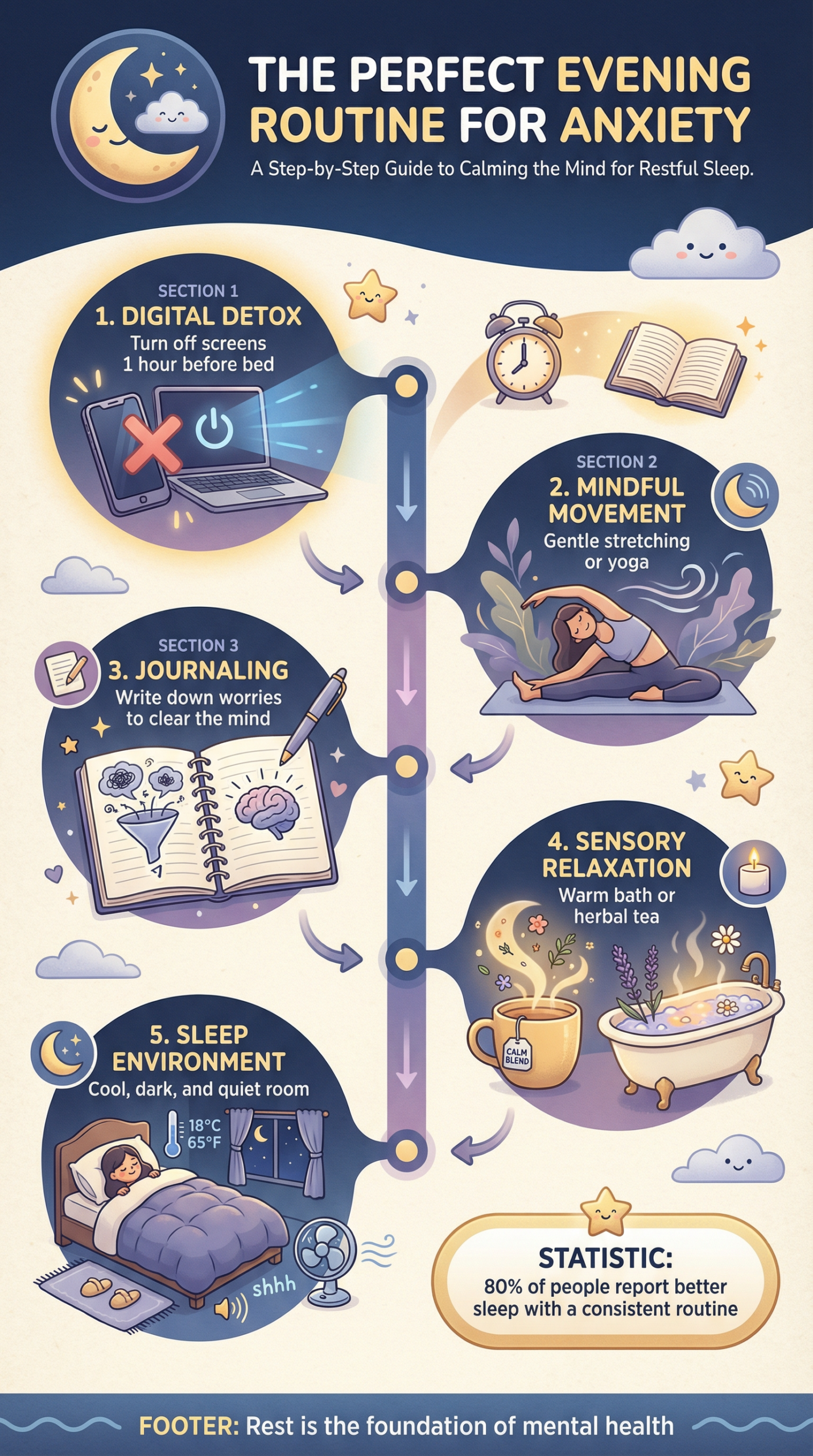
Calm Anxiety: The Perfect Evening Routine
A calming evening routine to ease anxiety before bed: wind-down steps, breathing and gentle habits that quiet a racing mind for better, deeper sleep.