Breathing Exercises for Anxiety: 7 Techniques to Calm Your Mind
Last updated:
Why Breathing Matters for Anxiety
When anxiety strikes, your breathing is one of the first things to change. It becomes shallow, rapid, and centred in your upper chest rather than your diaphragm. This type of breathing sends a signal to your brain that confirms the perceived threat, creating a feedback loop: anxiety causes shallow breathing, which causes more anxiety, which causes even shallower breathing.
The remarkable thing about breathing is that while it normally happens automatically, it is also one of the few bodily functions you can consciously control. This gives you a direct lever to influence your autonomic nervous system — the system that controls your heart rate, digestion, and stress response.
When you deliberately slow your breathing and extend your exhale, you activate the vagus nerve, which triggers your parasympathetic nervous system — your body’s built-in “calm down” mechanism. This reduces your heart rate, lowers blood pressure, relaxes your muscles, and sends a powerful message to your brain: “The threat has passed. We are safe.”
The NHS recommends breathing exercises as a frontline self-help technique for anxiety, and controlled breathing forms a core component of NICE-recommended therapies including CBT and applied relaxation.
Before You Begin: The Fundamentals
Before trying the specific techniques below, there are a few general principles worth understanding:
Breathe through your nose when possible. Nasal breathing filters, warms, and humidifies the air, and stimulates the parasympathetic nervous system more effectively than mouth breathing.
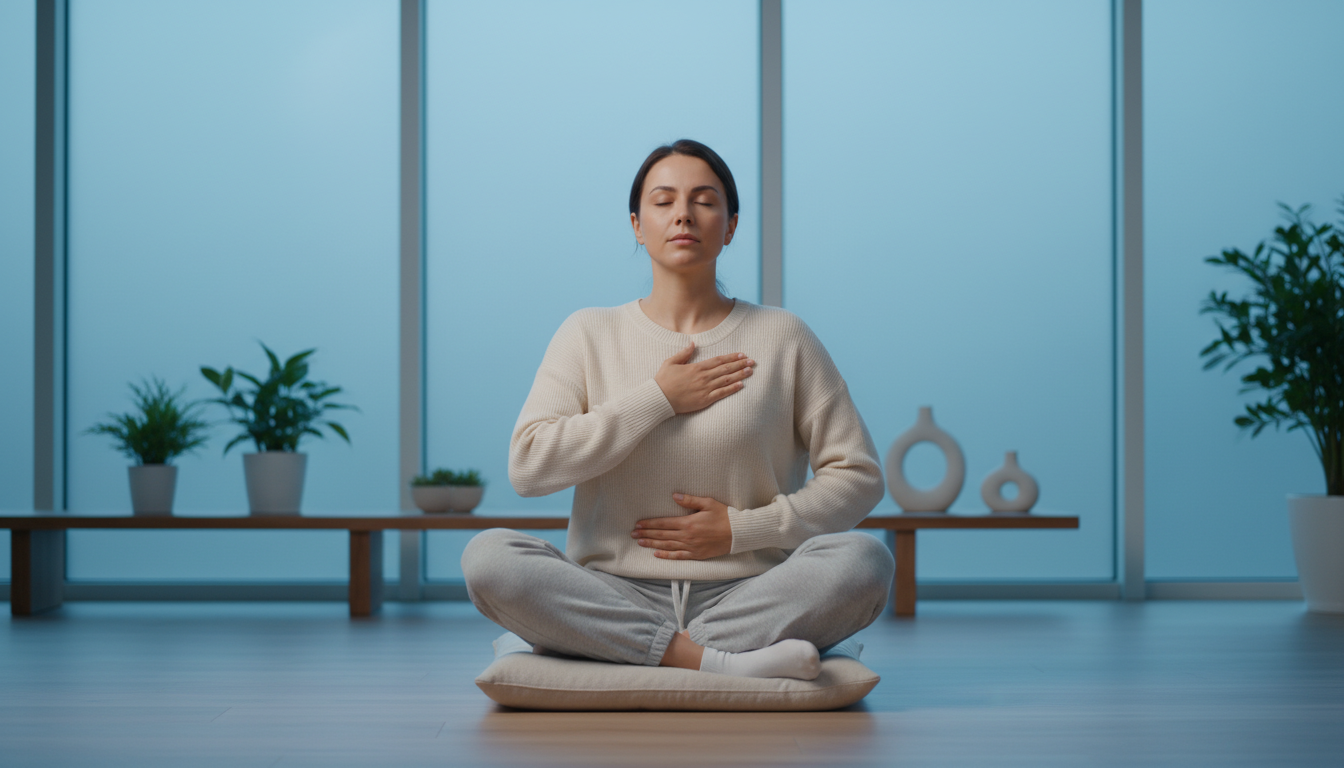
Breathe with your diaphragm. Place one hand on your chest and one on your abdomen. When you breathe in, the hand on your abdomen should rise while the hand on your chest stays relatively still. This is diaphragmatic breathing, and it is the foundation of all the techniques that follow.
Do not force it. These exercises should feel calming, not stressful. If any technique causes dizziness or discomfort, stop and return to your normal breathing. You can always try again later with shorter holds or gentler effort.
Practise when calm. Learning a new breathing technique during a panic attack is like trying to learn to swim in a storm. Practise regularly when you are relaxed so the technique becomes second nature.
7 Breathing Techniques for Anxiety
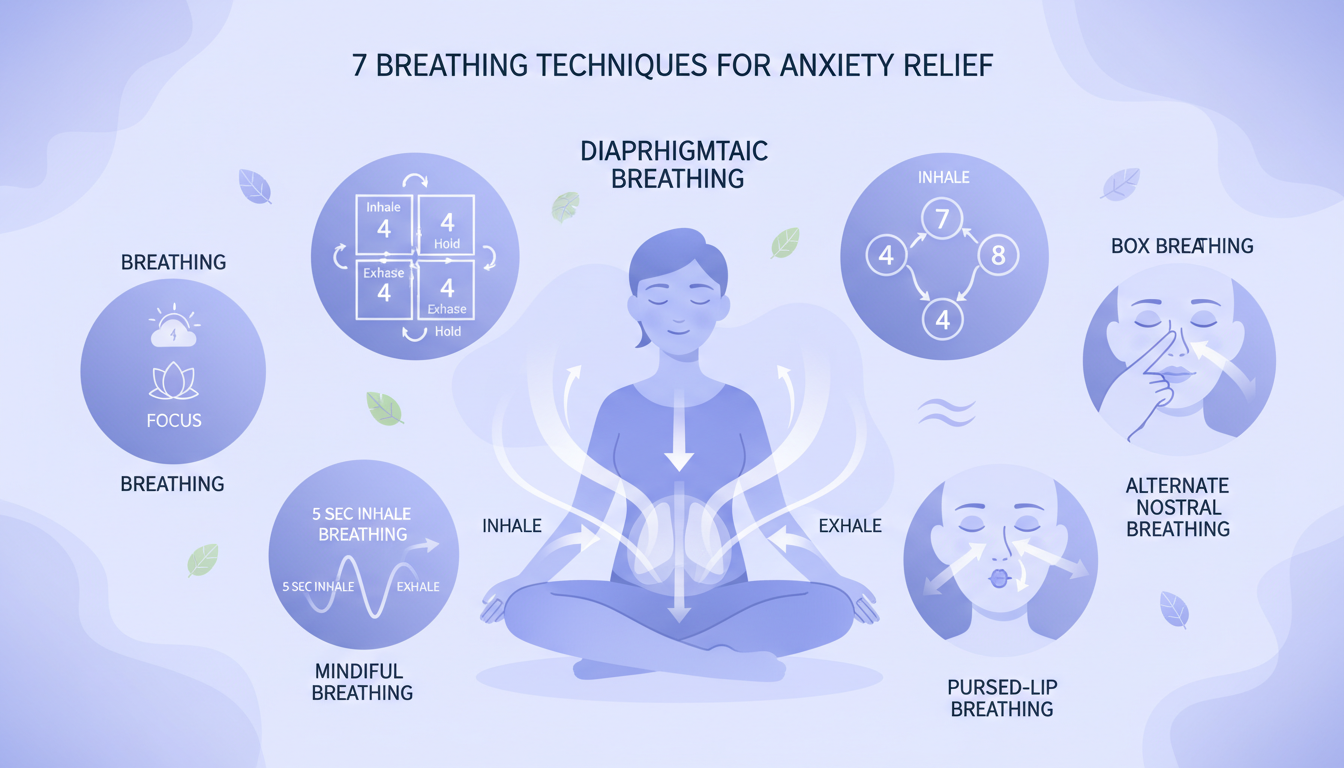
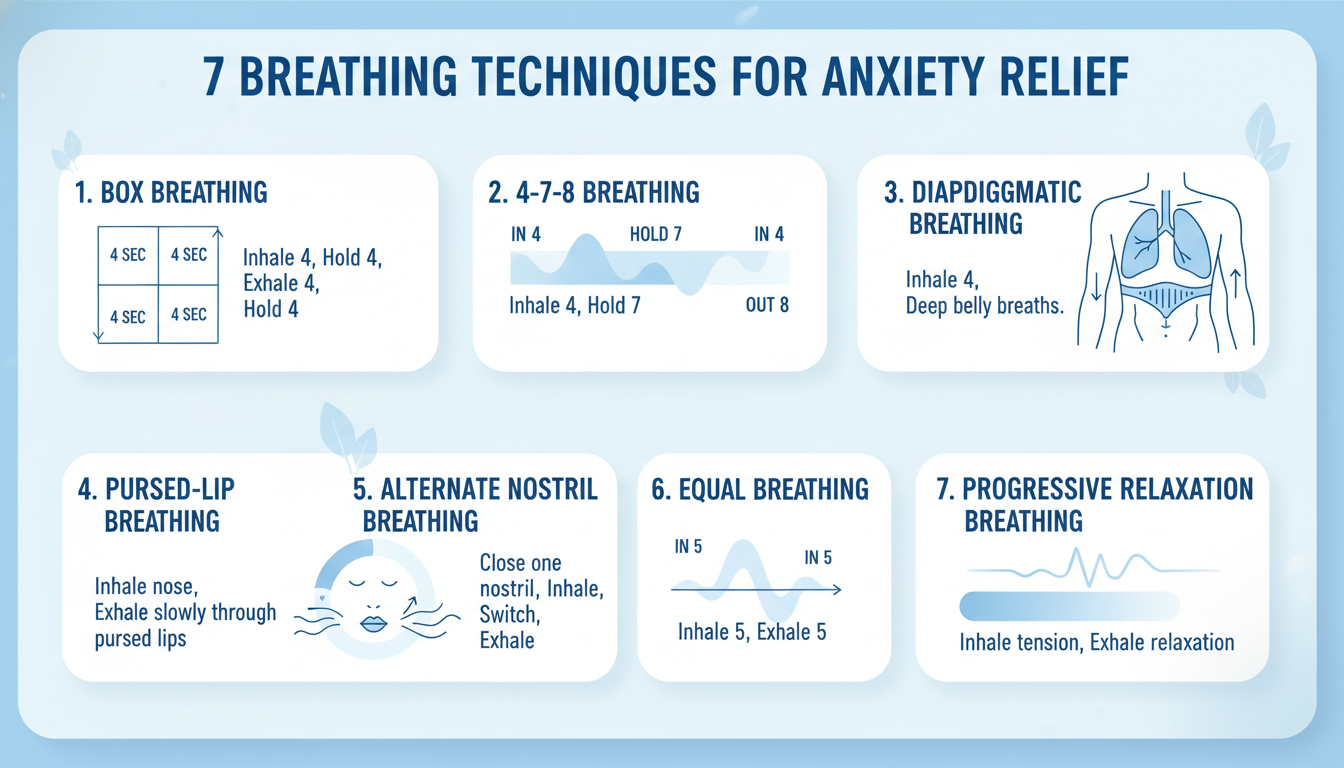
1. Diaphragmatic Breathing (Belly Breathing)
This is the foundational technique that underpins all the others. If you only learn one breathing exercise, make it this one.
How to do it:
- Sit comfortably or lie down. Place one hand on your chest and one on your belly.
- Breathe in slowly through your nose for 4 seconds, directing the breath into your belly. Your belly hand should rise; your chest hand should barely move.
- Breathe out slowly through your mouth for 6 seconds, as though gently blowing through a straw.
- Repeat for 5-10 minutes.
Why it works: Diaphragmatic breathing directly stimulates the vagus nerve and increases the volume of air entering your lungs, improving oxygen exchange and triggering the relaxation response.
Best for: Daily practice, mild to moderate anxiety, building the foundation for other techniques.
2. The 4-7-8 Technique
Popularised by Dr Andrew Weil, this technique is one of the most widely recommended by health professionals for anxiety and insomnia.
How to do it:
- Exhale completely through your mouth.
- Close your mouth and inhale quietly through your nose for 4 seconds.
- Hold your breath for 7 seconds.
- Exhale completely through your mouth for 8 seconds, making a gentle whooshing sound.
- This is one cycle. Complete 4 cycles to start with.
Why it works: The extended breath hold allows oxygen to fully saturate your blood, while the long exhale maximally stimulates the parasympathetic nervous system. The counting also occupies your mind, providing a distraction from anxious thoughts.
Best for: Acute anxiety, difficulty sleeping, moments when you need to calm down quickly.
3. Box Breathing (Square Breathing)
Box breathing is used by military personnel, emergency responders, and athletes to maintain composure under pressure. Its simplicity and regularity make it easy to remember and use in high-stress situations.
How to do it:
- Breathe in through your nose for 4 seconds.
- Hold your breath for 4 seconds.
- Breathe out through your mouth for 4 seconds.
- Hold your breath (lungs empty) for 4 seconds.
- Repeat for 4-6 cycles.
Why it works: The equal intervals create a rhythm that regulates your autonomic nervous system. The brief holds between breaths give your body time to balance oxygen and carbon dioxide levels.
Best for: Stressful situations at work, before presentations or exams, early stages of panic.
4. Alternate Nostril Breathing (Nadi Shodhana)
This technique originates from yogic breathing practices and has been the subject of several clinical studies showing its effectiveness for anxiety reduction.
How to do it:
- Sit comfortably and use your right thumb to gently close your right nostril.
- Inhale slowly through your left nostril for 4 seconds.
- Close your left nostril with your right ring finger, so both nostrils are closed. Hold for 2 seconds.
- Release your right nostril and exhale slowly through it for 4 seconds.
- Inhale through your right nostril for 4 seconds.
- Close both nostrils. Hold for 2 seconds.
- Release your left nostril and exhale through it for 4 seconds.
- This is one complete cycle. Repeat for 5-10 cycles.
Why it works: Research published in the International Journal of Yoga found that alternate nostril breathing significantly reduced both subjective anxiety and physiological markers of stress. The technique balances activity between the left and right hemispheres of the brain.
Best for: Pre-meditation calming, generalised anxiety, creating a sense of balance and equilibrium.
5. Resonant Breathing (Coherent Breathing)
Resonant breathing involves breathing at a rate of approximately 5 breaths per minute — roughly 6 seconds in and 6 seconds out. Research has shown that this specific rate maximises heart rate variability (HRV), which is associated with improved emotional regulation and reduced anxiety.
How to do it:
- Breathe in slowly through your nose for 6 seconds.
- Breathe out slowly through your nose or mouth for 6 seconds.
- Continue for 5-20 minutes.
Why it works: At 5 breaths per minute, your cardiovascular, respiratory, and autonomic nervous systems synchronise, creating a state of physiological coherence that is the opposite of the anxiety state.
Best for: Longer practice sessions, daily anxiety management, building resilience over time.
6. Pursed Lip Breathing
Originally developed for people with breathing difficulties, pursed lip breathing is also highly effective for anxiety because it naturally slows the breathing rate and extends the exhale.
How to do it:
- Relax your neck and shoulders.
- Inhale slowly through your nose for 2 seconds, keeping your mouth closed.
- Purse your lips as though you are about to whistle or blow out a candle.
- Exhale slowly and gently through your pursed lips for 4 seconds.
- Repeat for as long as needed.
Why it works: The pursed lips create gentle back-pressure, which slows the exhale and prevents the rapid, shallow breathing characteristic of anxiety. It is also very discreet and can be practised in any situation.
Best for: Discreet use in public, shortness of breath during anxiety, people who find other techniques too complicated initially.
7. Sighing Breath
Research from Stanford University, published in Cell Reports Medicine, found that a specific sighing breathing technique was more effective at reducing anxiety and improving mood than mindfulness meditation. This is the physiological sigh — a pattern your body naturally uses during sleep and crying to reset breathing.
How to do it:
- Take a deep breath in through your nose.
- At the top of the inhale, take a second, shorter sip of air through your nose (a double inhale).
- Exhale slowly and fully through your mouth in one long breath.
- Repeat 3-5 times.
Why it works: The double inhale reinflates the tiny air sacs (alveoli) in your lungs that collapse during shallow breathing, maximising the surface area for gas exchange. The extended exhale then efficiently removes carbon dioxide and activates the calming response. Just 5 minutes of this technique has been shown to produce significant anxiety reduction.
Best for: Rapid anxiety relief, people who want the fastest possible effect, those who find breath holding uncomfortable.
How to Build a Breathing Practice
Starting Out
Choose one technique that appeals to you and practise it daily for a week. Five minutes is sufficient to start with. Gradually increase to 10-15 minutes if you wish, though even brief daily practice yields significant benefits.
Creating Consistency
Attach your breathing practice to an existing habit — this is what behavioural scientists call “habit stacking.” For example:
- After your morning tea, practise 4-7-8 breathing for 5 minutes.
- Before eating lunch, do 4 cycles of box breathing.
- When you get into bed, practise resonant breathing until you feel drowsy.
Using Breathing in the Moment
When anxiety strikes unexpectedly, you will not have time to think about which technique is best. The physiological sigh and pursed lip breathing are the simplest to remember and deploy in the moment. Practise these specifically so they become automatic.
Common Questions
Can breathing exercises make anxiety worse? Occasionally, focusing on breathing can temporarily increase anxiety, especially if you feel you are not doing it “right.” If this happens, stop the exercise and focus on something else for a few minutes. You can return to it when you feel calmer. Never force a breathing technique.
How long before I notice a difference? Many people notice a difference within a single session. The physiological effects (reduced heart rate, lower blood pressure) begin within 2-3 minutes. The long-term benefits of regular practice — greater emotional resilience, lower baseline anxiety — develop over weeks.
Can I use these alongside medication or therapy? Absolutely. Breathing exercises complement all forms of anxiety treatment and are actively used within NICE-recommended therapies like CBT and applied relaxation.
Further Support
- NHS Every Mind Matters: Free online tools including guided breathing exercises.
- NHS Talking Therapies: Free therapy — self-refer online.
- Mind: Infoline 0300 123 3393 for information and support.
- Anxiety UK: Helpline 03444 775 774.
Your breath is always with you. It does not cost anything, it does not require an appointment, and it works within minutes. By making controlled breathing a regular part of your life, you are giving yourself one of the most powerful tools that exists for managing anxiety — one that is available every moment of every day.
Are you having a panic attack right now? Open the Panic SOS appFrequently Asked Questions
Why Breathing Matters for Anxiety?
When anxiety strikes, your breathing is one of the first things to change. It becomes shallow, rapid, and centred in your upper chest rather than your diaphragm. This type of breathing sends a signal to your brain that confirms the perceived threat, creating a feedback loop: anxiety causes shallow breathing, which causes more anxiety, which causes even shallower breathing.
How to Build a Breathing Practice?
Choose one technique that appeals to you and practise it daily for a week. Five minutes is sufficient to start with. Gradually increase to 10-15 minutes if you wish, though even brief daily practice yields significant benefits.
Which technique works fastest in the moment?
For Breathing Exercises for Anxiety, this question is best answered with personalised guidance. If you are concerned, speak to your GP or contact NHS 111. The article above outlines the most relevant evidence-based approaches.
Related Articles
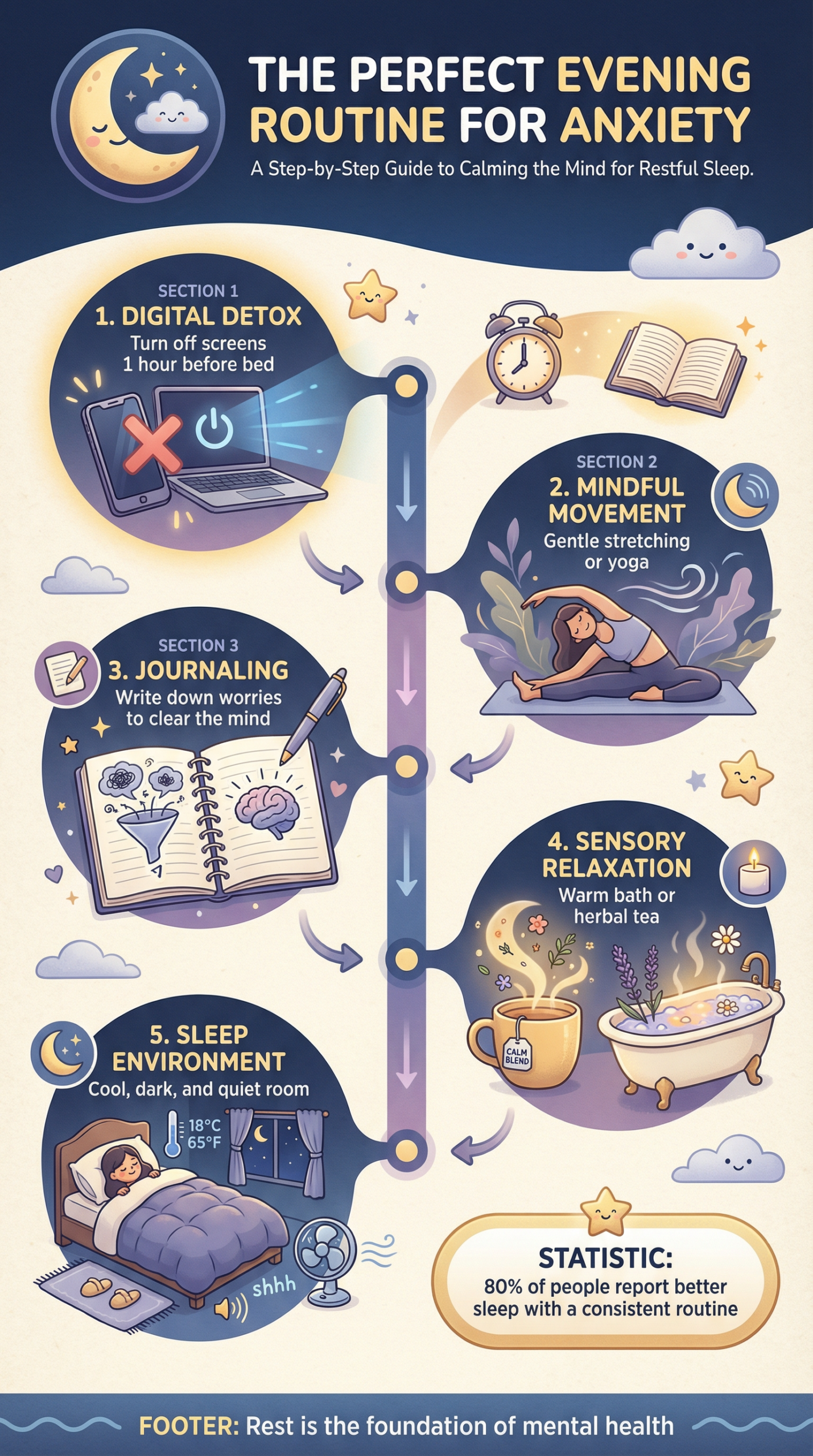
Calm Anxiety: The Perfect Evening Routine
A calming evening routine to ease anxiety before bed: wind-down steps, breathing and gentle habits that quiet a racing mind for better, deeper sleep.
CBT for Anxiety: How It Works, Techniques and How to Access It
Learn how CBT helps with anxiety, including 5 proven techniques you can practise at home. Find out how to access CBT on the NHS or privately in the UK.
Grounding Techniques for Anxiety: Exercises to Try Now
Grounding techniques can stop anxiety in its tracks. Try these simple, effective exercises to bring yourself back to the present moment.