
Grounding Techniques for Anxiety: Exercises to Try Now
Last updated:
What Are Grounding Techniques?
Grounding techniques are strategies that help anchor you in the present moment when anxiety, panic, or overwhelming emotions pull you into spiralling thoughts or a sense of disconnection. They work by engaging your senses, your body, or your conscious attention to interrupt the anxiety cycle and bring you back to the here and now.
When anxiety takes hold, your mind tends to race into the future — imagining worst-case scenarios, catastrophising about things that have not happened, or replaying past events with a critical lens. Grounding counters this by asking your brain to focus on something concrete, immediate, and real.
These techniques are widely used in evidence-based therapies including cognitive behavioural therapy (CBT) and dialectical behaviour therapy (DBT), and are recommended by NHS mental health services, Mind, and the Mental Health Foundation. They are safe, free, and can be used anywhere — at home, at work, on public transport, or in social situations.
How Grounding Works
To understand why grounding is effective, it helps to know what happens in your brain during anxiety. When your amygdala (the brain’s threat detection centre) perceives danger, it activates the fight-or-flight response. This triggers a cascade of physical and mental symptoms: rapid heartbeat, shallow breathing, muscle tension, and racing thoughts.
The prefrontal cortex — the rational, planning part of your brain — becomes less active during this process. Grounding techniques work by re-engaging the prefrontal cortex, essentially bringing your rational brain back online. When you deliberately focus on what you can see, hear, touch, or smell, you give your brain concrete information that says: “I am safe. I am here. There is no immediate threat.”
This does not mean grounding suppresses anxiety or pretends it is not there. Instead, it creates enough mental space for the intensity of the anxiety to begin decreasing naturally.
Sensory Grounding Techniques
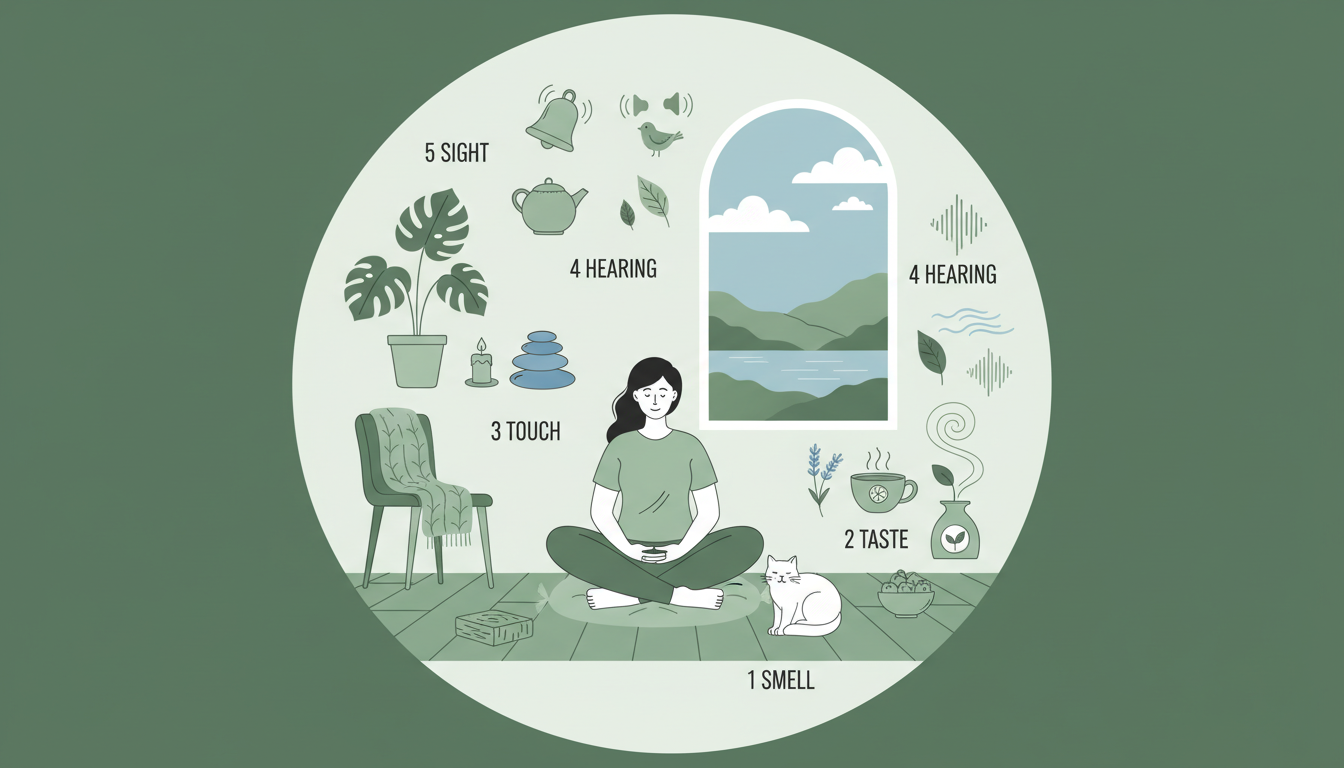
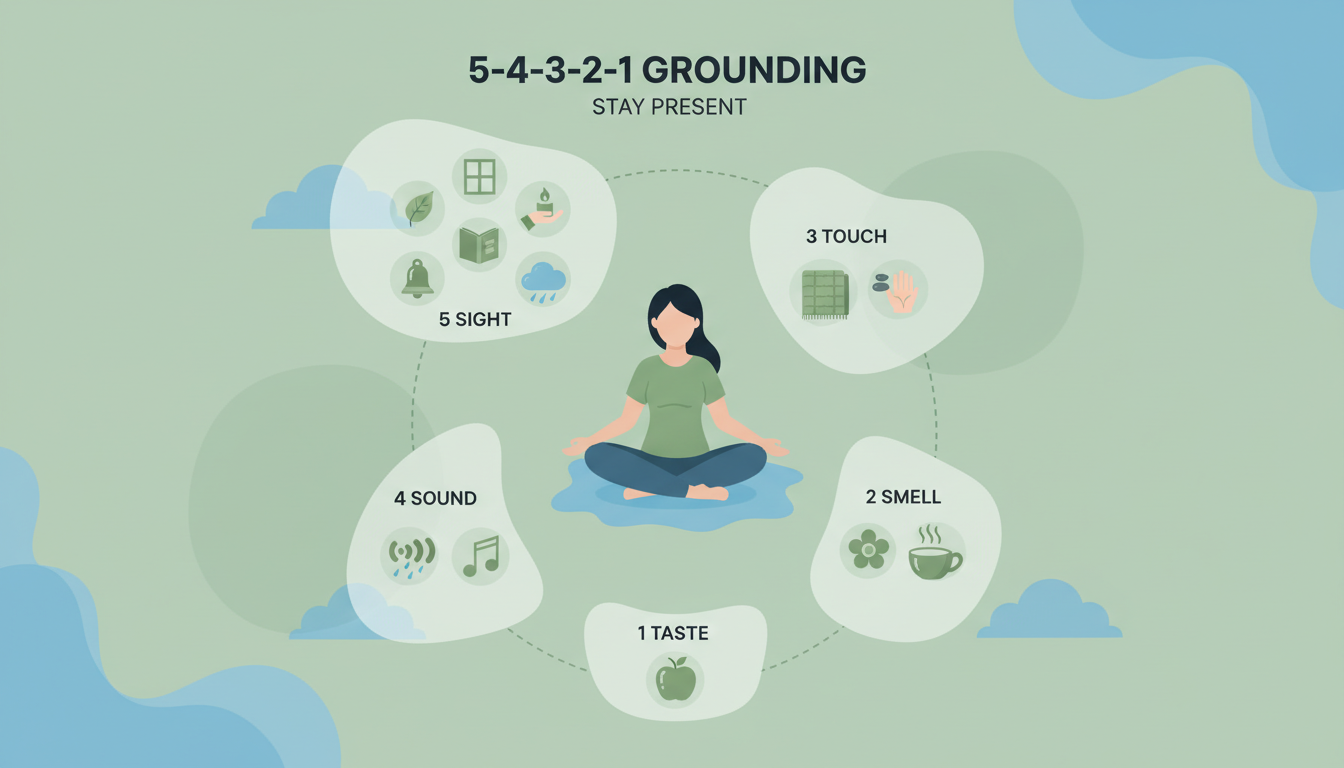
The 5-4-3-2-1 Technique
This is perhaps the most well-known grounding technique, recommended by therapists, NHS mental health services, and charities including Mind. It systematically engages all five senses to anchor you in the present.
How to do it:
- 5 things you can see: Look around deliberately. Name five things you can see — a crack in the ceiling, a blue pen, the pattern on a curtain. Describe them in detail in your mind.
- 4 things you can touch: Notice the texture of your clothes against your skin, the weight of your body in the chair, the smoothness of your phone, the warmth of your hands. Focus on how each one feels.
- 3 things you can hear: Listen carefully. Perhaps a clock ticking, traffic outside, the hum of a refrigerator, birdsong, or distant voices.
- 2 things you can smell: This might require you to actively seek out scents — your coffee, hand cream, the air coming through a window, or even the fabric of your jumper.
- 1 thing you can taste: Notice any taste in your mouth, take a sip of water, or keep a small sweet or piece of chewing gum handy for this purpose.
By the time you have worked through all five senses, your focus has shifted significantly from anxious thoughts to your immediate environment, and your nervous system has had time to begin calming down.
The Colour Game
Choose a colour and look around your environment, finding and naming every object of that colour. This is a simplified version of visual grounding that works well when you need something quick and discreet.
Sound Awareness
Close your eyes and focus exclusively on what you can hear. Start with the most obvious sounds, then gradually listen for quieter, more distant ones. Try to identify at least five different sounds. This technique is particularly useful in busy environments where visual focus might be difficult.
Temperature Grounding
Temperature changes are powerful grounding tools because they create a strong physical sensation that is difficult for your brain to ignore.
- Hold an ice cube in your palm and focus on the cold sensation.
- Splash cold water on your face or wrists.
- Step outside briefly and notice the temperature of the air on your skin.
- Hold a warm mug of tea and focus on the warmth spreading through your hands.
Physical Grounding Techniques
The Body Scan
A body scan involves slowly directing your attention through each part of your body, noticing sensations without trying to change them. This technique is used in mindfulness-based stress reduction (MBSR) and is recommended by the Mental Health Foundation.
How to do it:
- Sit or lie in a comfortable position.
- Start at the top of your head and slowly move your attention downward.
- Notice each area: forehead, eyes, jaw, neck, shoulders, arms, hands, chest, stomach, hips, legs, feet.
- For each area, simply notice what you feel — tension, warmth, tingling, numbness, nothing at all.
- Do not try to change anything. Simply observe.
A full body scan takes 10-20 minutes, but even a brief 2-minute version focusing on your hands, feet, and breathing can be effective during acute anxiety.
Feet on the Floor
This deceptively simple technique involves pressing your feet firmly into the floor and focusing all your attention on the physical sensation of contact between your feet and the ground.
Notice the weight distributed across your soles. Push down slightly and feel the solidity of the floor beneath you. Wiggle your toes inside your shoes. This technique works because it literally grounds you — connecting you to the physical earth beneath your feet.
Hand Exercises
Your hands are rich in nerve endings, making them excellent tools for grounding.
- Finger counting: Touch each finger to your thumb in sequence, counting as you go. Then reverse the sequence.
- Hand massage: Use one hand to massage the other, paying attention to each finger, your palm, and the back of your hand.
- Object holding: Hold a small textured object — a pebble, a keyring, a piece of fabric — and explore its texture, weight, and temperature in detail.
The Butterfly Hug
Developed as part of EMDR therapy and now widely used as a standalone grounding technique, the butterfly hug involves crossing your arms over your chest and alternately tapping your shoulders gently, left then right, at a slow, steady pace. This bilateral stimulation has been shown to have a calming effect on the nervous system.
Mental Grounding Techniques
Categories Game
Choose a category and list as many items as you can think of. For example: types of dog, countries in Europe, songs by your favourite artist, characters from a book you have read. This engages your cognitive brain and redirects attention away from anxious thoughts.
Counting Exercises
Counting exercises provide a structured mental task that interrupts anxiety spirals:
- Count backwards from 100 by 7s (100, 93, 86, 79…).
- Count all the right angles in the room.
- Count your breaths up to 10, then start again.
Describe Your Surroundings
Describe your environment in factual, neutral detail, either aloud or in your mind. “I am sitting in a grey office chair. The desk in front of me is wooden with a dark stain. There is a white mug to my left with a small chip on the handle.” This objective narration engages your observing mind and disengages the anxious mind.
Positive Memory Recall
Bring to mind a positive memory in vivid sensory detail. Where were you? What could you see, hear, smell? How did your body feel? The more sensory detail you include, the more effective this technique is at shifting your emotional state.
Creating Your Grounding Kit
Many people find it helpful to create a small grounding kit that they can carry with them or keep in their desk drawer. This might include:
- A smooth pebble or worry stone
- A small bottle of essential oil (peppermint or lavender)
- A textured fabric or stress ball
- A piece of strong-flavoured chewing gum or a mint
- A photo that brings positive memories
- A card with your favourite grounding technique written on it
When to Use Grounding Techniques
Grounding techniques are most useful during:
- Acute anxiety or the onset of a panic attack
- Moments of dissociation (feeling disconnected from reality)
- Emotional overwhelm
- Flashbacks related to traumatic experiences
- Difficulty sleeping due to racing thoughts
- Anxiety-provoking situations (before a presentation, in a crowded space)
However, practising grounding regularly — not just during crises — makes the techniques more effective and more automatic when you truly need them.
Making Grounding a Daily Practice
Like any skill, grounding becomes more effective with practice. Consider:
- Starting each day with a brief 5-4-3-2-1 exercise.
- Doing a body scan before bed to promote better sleep.
- Practising the feet-on-the-floor technique during your commute.
- Using meal times as an opportunity for mindful, sensory-focused eating.
When to Seek Additional Support
Grounding techniques are a valuable part of an anxiety management toolkit, but they are not a complete treatment for anxiety disorders. If your anxiety is persistent, worsening, or significantly affecting your daily life, please consider reaching out for professional support.
- NHS Talking Therapies: Free psychological therapy — self-refer online.
- Mind: Infoline 0300 123 3393.
- Anxiety UK: Helpline 03444 775 774.
- Samaritans: 116 123 (free, 24/7).
- SHOUT: Text SHOUT to 85258 for crisis support.
Grounding techniques remind you of something anxiety tries to make you forget: you are here, you are safe, and this moment — right now — is manageable. The more you practise, the more naturally this awareness will come when you need it most.
Related Articles

Breathing Exercises for Anxiety: 7 Techniques to Calm Your Mind
Breathing exercises are one of the fastest ways to calm anxiety. Try these 7 techniques and feel the difference in minutes.
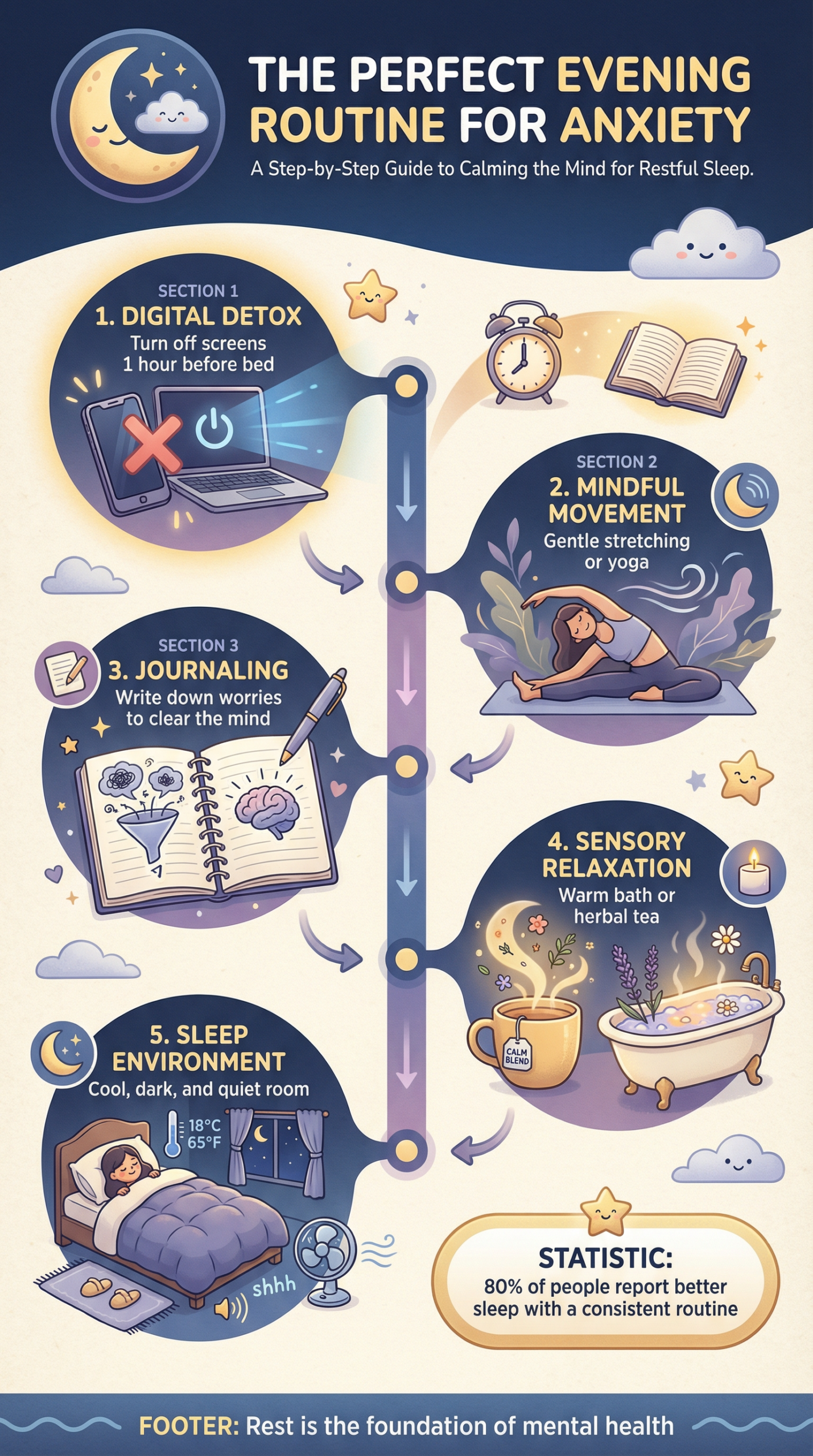
Calm Anxiety: The Perfect Evening Routine
Evening Routine to Ease Down Anxiety: A Comprehensive Guide Anxiety has become a common part of modern life, affecting millions worldwide. With the constant demands of work, social...

CBT for Anxiety: How It Works, Techniques and How to Access It
Learn how CBT helps with anxiety, including 5 proven techniques you can practise at home. Find out how to access CBT on the NHS or privately in the UK.