
Can You Have Anxiety and Depression at the Same Time? Yes: 5 Strategies
Can you have anxiety and depression at the same time? Yes, and if that is what is happening to you, you are not an unusual or complicated case: you are in the majority. Around half of people diagnosed with depression also meet the criteria for an anxiety disorder, and in England the Adult Psychiatric Morbidity Survey has repeatedly found that mixed anxiety and depression is the most common mental health condition of all, affecting roughly 8 in 100 adults in any given week, a figure Mind and other UK charities cite in their own reporting.
This guide, part of our managing anxiety resources, explains why the two conditions travel together, what “mixed anxiety and depressive disorder” actually means, how the NHS approaches the combination, and five practical strategies chosen specifically because they help both conditions at once.
Why anxiety and depression feed each other
On paper they look like opposites: anxiety is revved-up dread about what might happen, depression is flattened weight about what already feels true. In a real nervous system they interlock.
They share machinery: both involve the brain’s threat and mood circuits, both disturb sleep, both are amplified by stress hormones, and both run on repetitive negative thinking, worry pointed at the future in anxiety, rumination pointed at the past in depression.
And they create each other’s conditions. Months of anxiety are exhausting: the constant alertness, the avoided situations, the shrinking life, and exhaustion plus a shrinking life is fertile ground for depression. In the other direction, depression strips away energy and confidence, so ordinary tasks start to feel threatening, and new anxieties grow around them. The result is a loop, and the loop, not either condition alone, is what good treatment targets.
Symptoms of depression and anxiety together
When the two overlap, people typically feel some mix of the following. You do not need every item for the combination to be real:
- From the anxiety side: persistent worry, restlessness, a racing heart, tension, irritability, dread without a clear object.
- From the depression side: low mood most of the day, loss of interest or pleasure, low energy, feelings of worthlessness or guilt, tearfulness.
- Shared ground: disturbed sleep, poor concentration, appetite changes, withdrawing from people, and being drained rather than restored by rest.
A characteristic signature of the combination is agitated exhaustion: too tired to do anything, too wired to rest. Many people also describe the conditions taking shifts, anxiety running the day and low mood arriving at night, or an anxious morning dread giving way to flat hopelessness by evening. Our guides to mental symptoms of anxiety and what anxiety feels like cover the anxiety half in more depth.
Mixed anxiety and depressive disorder, explained
The term has a precise clinical meaning, and it is worth knowing because it describes an enormous number of people. Mixed anxiety and depressive disorder is the diagnosis used, in the international ICD classification the NHS works with, when someone has genuine symptoms of both anxiety and depression at the same time, but neither set alone is severe enough to meet the full criteria for a separate anxiety disorder or depressive episode.
Three things matter about it:
- It is the most common pattern, not a footnote. The Adult Psychiatric Morbidity Survey found mixed anxiety and depression more common in England than any single anxiety disorder or depression alone.
- “Sub-threshold” does not mean mild. Two half-conditions can add up to more disruption than one full one: the combination still costs sleep, work, relationships and quality of life, and research links it to real functional impairment.
- It is treatable through the normal routes. There is no special clinic for it; assessment and treatment run through your GP and NHS Talking Therapies exactly as for anxiety or depression alone, which is good news, because it means the front door is the same and you do not need to arrive with the right label.
If a GP or therapist uses this term about you, it is not a verdict of “not bad enough to count”. It is a recognised condition with recognised treatment.
Getting help through the NHS
Start with your GP, who can assess both sets of symptoms, rule out physical contributors such as thyroid problems, and map the options. In England you can also refer yourself directly to NHS Talking Therapies without a GP appointment; in Scotland, Wales and Northern Ireland your GP is the main route into local services.
Treatment usually starts with the condition causing the most impairment, but the tools overlap heavily. Talking therapies, particularly CBT, treat both anxiety and depression and teach skills that interrupt the loop between them; our guide to NHS Talking Therapies walks through the referral process. Where medication is appropriate, some antidepressants are used for both conditions, which is one reason a single prescriber can treat the pair. A note on supplements, because search results push them hard here: evidence is mixed at best, and St John’s wort in particular interacts with many prescribed medicines, including antidepressants and contraception, so nothing should be added without checking with a GP or pharmacist.
If you are reading this for someone you love rather than for yourself, our guide on how to cope with a partner with depression covers the supporting role, which has its own challenges.
Five strategies that help both at once
These five are chosen because each one works on both conditions simultaneously, and none requires feeling motivated first. Start smaller than feels reasonable.
1. Anchor the day with one fixed point. Depression dissolves structure; anxiety fills the vacuum with worry. Reclaim one anchor: get up at the same time, shower, make breakfast, step outside briefly. One kept promise to yourself steadies mood and gives worry less open ground.
2. Move, gently and daily. Physical activity is one of the few interventions with solid evidence for both anxiety and depression, and NICE recommends it within treatment for low mood. Aim for consistency over intensity: a 15-minute daily walk beats a weekly gym heroic. Movement burns off anxious arousal and counters depressive shutdown in the same half hour.
3. Have a two-minute tool for spikes. When anxiety surges, use slow breathing, in for four counts and out for six, for ten breaths, or the 5-4-3-2-1 grounding exercise. These do not cure anything; they get you through the wave so the day continues, which protects the structure that protects your mood. Practise them calm so they work under pressure.
4. Stay connected, in minimum viable doses. Both conditions push isolation, and isolation feeds both. You do not need to be sociable; you need contact. A message sent, a short call, a walk with one person. Tell at least one person the truth about how you are: secrecy is heavy, and both anxiety and depression get worse under it.
5. Track something, gently. Both conditions distort memory: anxiety insists nothing is safe, depression insists nothing has ever helped. A brief daily note of mood, sleep and one thing you did gives you evidence instead. Our free, confidential anxiety test and depression test take a couple of minutes each; retaking them every few weeks shows movement that feelings hide, and the results are useful to bring to a GP appointment.
When to seek help
See your GP if low mood or worry has lasted more than a couple of weeks, is affecting sleep, work or relationships, or keeps returning. Go sooner if you are using alcohol or other substances to cope. If you have thoughts of harming yourself and feel unsafe right now, call 999 or go to A&E. For urgent mental health advice that is not life-threatening, contact NHS 111, and Samaritans are there around the clock on 116 123, free, whenever you need someone to listen. For a fuller list of UK support options, see our guide to mental health resources in the UK.
Having both conditions at once can feel like proof that something is uniquely wrong with you. The numbers say the opposite: it is the most common shape distress takes, the NHS treats it every day, and both halves respond to the same well-evidenced help. Start with one strategy from the five, and one appointment.
Frequently Asked Questions
Can you have anxiety and depression at the same time?
Yes, and it is extremely common. Around half of people diagnosed with depression also have an anxiety disorder, and UK surveys find that mixed anxiety and depression is the most frequently identified common mental health condition in England. The two feed each other, which is why treating only one often is not enough, and why it is worth telling your GP about both sets of symptoms.
What is mixed anxiety and depressive disorder?
It is a diagnosis used when someone has real symptoms of both anxiety and depression at the same time, but neither set is severe enough on its own to meet the full criteria for an anxiety disorder or a depressive episode. It is not a milder problem, since the combination can be very disabling. Treatment follows the same routes as anxiety and depression generally, starting with talking therapies.
Which comes first, anxiety or depression?
Either can. Anxiety often appears earlier in life and long-term anxiety can wear a person down into depression, while depression's withdrawal and low energy can create new worries and fears. In practice the order matters less than the loop the two create together, and treatment targets that loop rather than just whichever came first.
How are anxiety and depression treated together on the NHS?
Through the same front door. Your GP or NHS Talking Therapies will assess both sets of symptoms and usually start with the one causing most impairment. Talking therapies, particularly CBT, work on both conditions, and if medication is appropriate, some antidepressants are used for both anxiety and depression. In England you can self-refer to NHS Talking Therapies without seeing your GP first.
When should I see a GP about anxiety and low mood?
If low mood, loss of interest or persistent worry has lasted more than about two weeks, is affecting sleep, work or relationships, or you are using alcohol to cope, book a GP appointment. Seek urgent help through 999 or A&E if you have thoughts of harming yourself and feel unsafe now, or contact NHS 111 for urgent advice; Samaritans are available any time on 116 123.
Related Articles

CBT for Anxiety: How It Works, Techniques and How to Access It
Learn how CBT helps with anxiety, including 5 proven techniques you can practise at home. Find out how to access CBT on the NHS or privately in the UK.
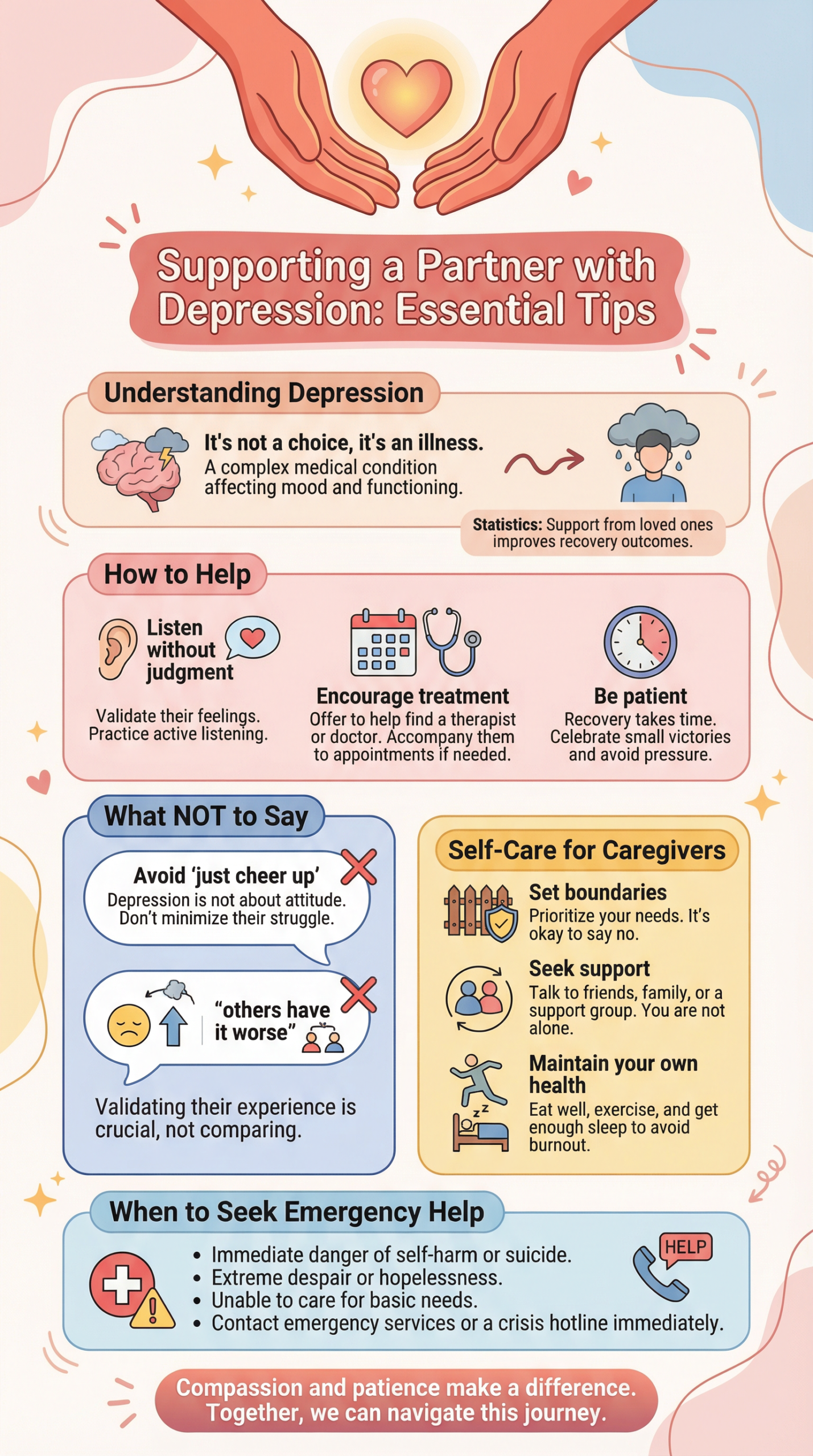
Essential Tips on How to Cope with a Partner with Depression
How to support a partner with depression while protecting your own wellbeing — practical ways to listen, encourage help and cope as a couple together.

How to Manage Anxiety: Self-Help That Works Without Medication
Learn how to manage anxiety without medication with NHS-backed self-help techniques, daily habits, CBT tools and prevention tips, plus when to seek professional support in the UK.