
Anxiety in Social Situations: Practical Coping Strategies
Last updated:
Introduction: More Than Just Shyness
Everyone feels nervous in certain social situations from time to time. A flutter of nerves before a first date, a moment of self-consciousness when walking into a room full of strangers, a quickening pulse before giving a speech: these are normal, universal experiences. But for people with social anxiety, these moments are not fleeting discomforts; they are overwhelming, consuming, and often debilitating.
Social anxiety disorder (also known as social phobia) is one of the most common mental health conditions in the United Kingdom. Research suggests it affects approximately 12% of people at some point in their lives, though many never seek help because the very nature of the condition makes it difficult to reach out. According to NICE, the average delay between onset of social anxiety symptoms and seeking treatment is over 15 years.
This article offers practical, evidence-based strategies for managing anxiety in social situations, whether you experience occasional social nervousness or a more persistent social anxiety disorder.
Understanding Social Anxiety
What Is Social Anxiety Disorder?
Social anxiety disorder is characterised by a marked and persistent fear of social situations in which you might be scrutinised, evaluated, or judged by others. This fear is disproportionate to the actual threat posed by the situation and causes significant distress or impairment in daily functioning.
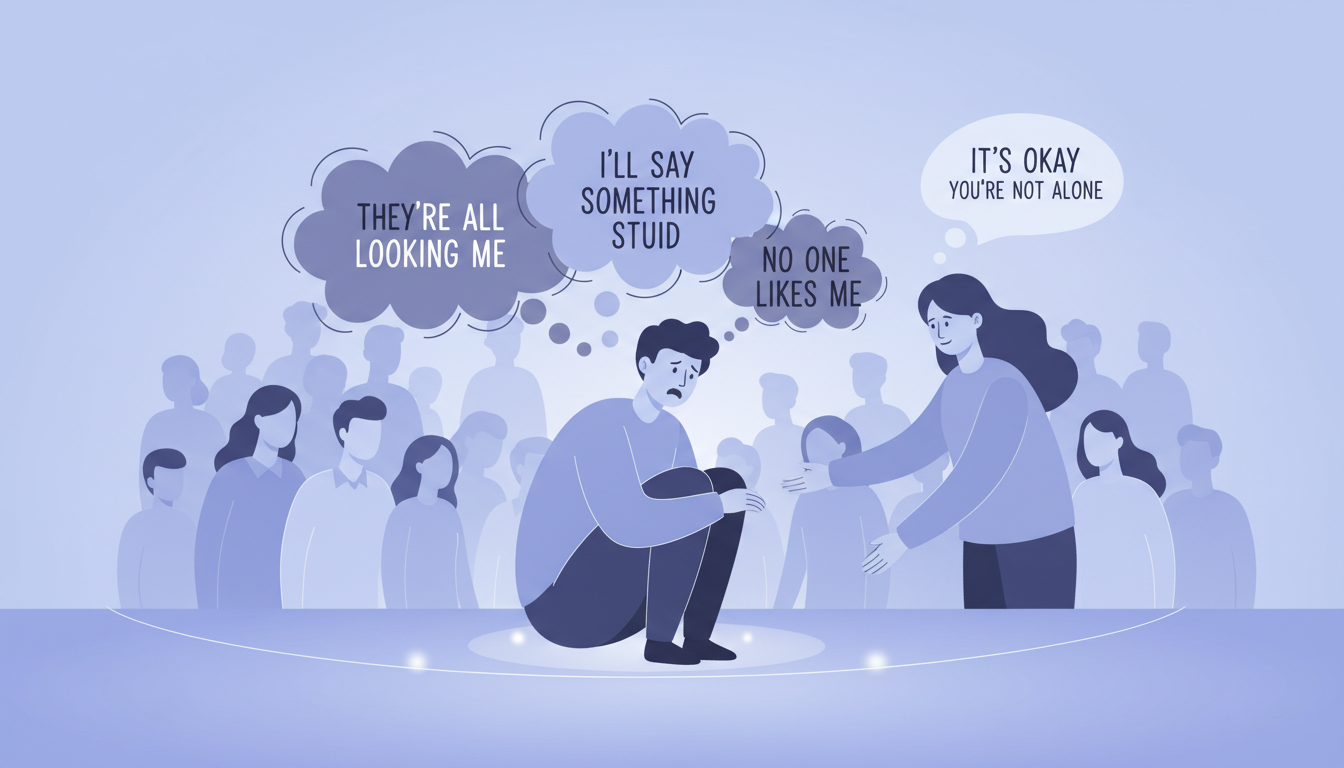
Common feared situations include:
- Speaking in front of groups, even small ones
- Meeting new people
- Eating or drinking in front of others
- Being the centre of attention
- Making phone calls, especially to people you do not know
- Using public toilets
- Entering a room where people are already seated
- Being watched while doing something (writing, working, exercising)
- Parties, networking events, and social gatherings
The Core Fear
At the heart of social anxiety is a fear of negative evaluation. You may fear that you will say something stupid, that others will notice your anxiety, that you will be judged as boring, weird, or incompetent, or that you will do something embarrassing. This fear is not simply about disliking social situations; it is about a deep-seated belief that you are somehow inadequate and that this inadequacy will be exposed.
The Role of Safety Behaviours
People with social anxiety often develop “safety behaviours”: strategies designed to prevent the feared outcome. These might include rehearsing everything you plan to say, avoiding eye contact, speaking very quietly, gripping a glass tightly to hide trembling hands, wearing dark clothing to hide sweat patches, or arriving early to avoid entering a room full of people.
While these behaviours may provide temporary relief, they actually maintain the anxiety in the long run. They prevent you from learning that the feared outcome is unlikely to happen, and they keep your attention focused inward on your own perceived flaws rather than on the actual social interaction.
The Physical Side of Social Anxiety
Social anxiety is not just a mental experience; it produces powerful physical symptoms that can be extremely distressing, particularly because many of them are visible to others. Common physical symptoms include:
- Blushing
- Sweating, particularly on the face, palms, and underarms
- Trembling hands and voice
- Dry mouth
- Nausea or stomach churning
- Heart palpitations
- Muscle tension
- Mind going blank
- Feeling faint or dizzy
The fear of others noticing these physical symptoms often becomes a major source of anxiety in itself, creating a secondary layer of worry on top of the original social fear.
Practical Coping Strategies
Before a Social Situation
Challenge your predictions: Before a social event, notice what your mind is predicting will happen. Write down the worst-case scenario, then ask yourself: “How likely is this, really? What is the evidence for and against? What would I say to a friend who had this worry?” This cognitive restructuring is a core CBT technique.
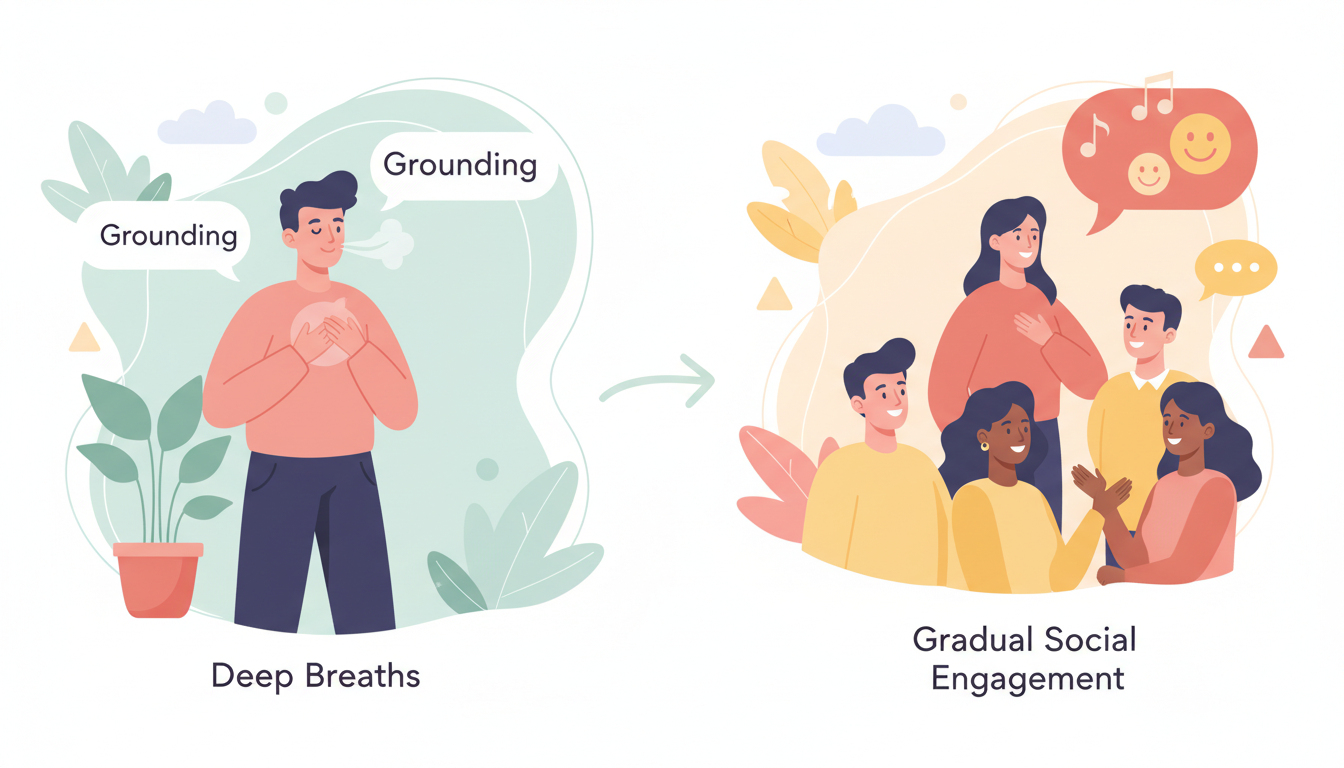
Prepare, but do not over-prepare: It is helpful to have a few conversation topics or questions ready, but excessive rehearsal can increase anxiety. Aim for a balance between preparation and flexibility.
Set realistic goals: Instead of expecting yourself to be the life of the party, set a small, achievable goal such as “I will start one conversation” or “I will stay for 30 minutes.”
Arrive at a time that suits you: Some people find arriving early, when there are fewer people, less overwhelming. Others prefer arriving when the event is already underway, so they can blend in. Experiment to find what works for you.
During the Social Situation
Shift your attention outward: A key feature of social anxiety is self-focused attention, the tendency to monitor yourself constantly for signs of anxiety. Deliberately redirect your attention to the other person: what are they saying? What are they wearing? What questions can you ask them? This reduces self-consciousness and often improves the quality of the interaction.
Drop safety behaviours: This is challenging but powerful. Try gradually reducing your reliance on safety behaviours. If you normally avoid eye contact, try making brief eye contact. If you usually stand in the corner, try positioning yourself more centrally. Each time you drop a safety behaviour and nothing catastrophic happens, your brain receives evidence that you can cope.
Use grounding techniques: If anxiety spikes, press your feet firmly into the floor, notice the sensation of the chair beneath you, or hold something cool in your hands. These sensory inputs anchor you in the present moment.
Accept imperfection: You do not need to be witty, charming, or fascinating. Most people are simply looking for someone who is friendly and interested. Asking questions and listening attentively is often more valued than being entertaining.
After the Social Situation
Resist the urge to post-mortem: People with social anxiety often engage in extensive “post-event processing,” replaying the event in their mind and focusing on everything they believe went wrong. This process is biased toward the negative and increases anxiety about future events. When you notice yourself doing this, gently redirect your attention to something else.
Acknowledge what you achieved: Rather than focusing on what felt difficult, acknowledge the fact that you attended and participated. Every social situation you face, regardless of how it went, is a step toward reducing your anxiety.
Evidence-Based Treatment
CBT for Social Anxiety
NICE recommends individual CBT specifically designed for social anxiety disorder as the first-line treatment. This typically involves 12 to 16 sessions and includes:
- Developing a personalised model: Understanding how your thoughts, behaviours, physical symptoms, and attention patterns interact to maintain your anxiety
- Cognitive restructuring: Learning to identify and challenge unhelpful thoughts and beliefs
- Behavioural experiments: Testing your fears in real social situations to gather evidence about what actually happens
- Attention training: Practising shifting your focus from internal monitoring to external engagement
- Dropping safety behaviours: Gradually reducing reliance on coping strategies that maintain anxiety
- Video feedback: Watching recordings of yourself in social situations to challenge distorted self-perceptions
CBT for social anxiety is available through NHS Talking Therapies, and you can self-refer in most areas of England.
Medication
If CBT is not available, not suitable, or if you prefer a different approach, NICE recommends escitalopram or sertraline (SSRIs) as first-line medication options for social anxiety disorder. These can reduce the intensity of anxiety and make it easier to engage in social situations and therapy. Your GP can discuss whether medication might be appropriate for you.
Self-Help Resources
NICE also recognises the value of guided self-help based on CBT principles. Books such as “Overcoming Social Anxiety and Shyness” by Gillian Butler are recommended and can be accessed through the NHS Reading Well Books on Prescription scheme at your local library.
Building Confidence Over Time
Recovery from social anxiety is not about becoming an extrovert or never feeling nervous again. It is about reducing the fear to a manageable level and building confidence that you can handle social situations even when you do feel some anxiety. This happens through gradual, repeated exposure to feared situations, combined with a shift in the beliefs that drive the fear.
Progress may be slow, and there will be setbacks. That is normal. What matters is the overall trajectory. With each social situation you navigate, you are building evidence that you can cope, that the worst-case scenario rarely happens, and that you are more capable than your anxiety tells you.
UK Resources
- NHS Talking Therapies: Free CBT and other therapy. Self-referral available.
- Mind: Information on social anxiety and local support. Infoline: 0300 123 3393.
- Anxiety UK: Specialist support including therapy access. Helpline: 03444 775 774.
- Social Anxiety UK: A peer-support community specifically for social anxiety. Website: social-anxiety.org.uk.
- Reading Well Books on Prescription: Free access to recommended self-help books through your local library.
Conclusion
Social anxiety is one of the most treatable anxiety disorders, yet it remains one of the most underdiagnosed and undertreated. If social situations cause you significant distress or if you find yourself increasingly avoiding them, please know that effective help is available. You do not have to navigate this alone. With the right support, whether through therapy, self-help, medication, or a combination, most people with social anxiety experience meaningful improvement. The social world is waiting for you, and you have more to offer it than your anxiety lets you believe.
Related Articles

Relationship Anxiety: Signs, Causes and How to Cope
Relationship anxiety can affect even the healthiest partnerships. Learn the signs, causes, and evidence-based strategies to cope with anxiety in relationships.
Sleep Anxiety: Causes, Symptoms and How to Break the Cycle
Sleep anxiety keeps millions awake at night. Learn what causes it, how to recognise the symptoms, and evidence-based techniques to finally get restful sleep.

Anxiety at Work: Managing Workplace Anxiety Effectively
Workplace anxiety affects millions in the UK. Discover practical strategies to manage anxiety at work and protect your performance.