
Anxiety at Work: Managing Workplace Anxiety Effectively
Last updated:
Introduction: The Scale of Workplace Anxiety in the UK
Work is the single most commonly cited source of stress and anxiety in the United Kingdom. According to the Health and Safety Executive (HSE), work-related stress, depression, and anxiety accounted for 49% of all work-related ill health in 2022/23, with 875,000 workers affected. The total number of working days lost to these conditions was 17.1 million, representing a significant cost to individuals, organisations, and the economy.
Behind these statistics are real people struggling to get through each working day. The colleague who dreads Monday mornings with a physical ache. The employee who spends hours agonising over a simple email. The manager who lies awake at night worrying about their team’s performance. The graduate who feels sick with anxiety before every meeting. Workplace anxiety takes many forms, but its impact is consistently profound.
This article provides practical, evidence-based guidance for managing anxiety at work, understanding your rights, and knowing where to turn for support.
What Does Workplace Anxiety Look Like?
Workplace anxiety can present differently from person to person, but common manifestations include:
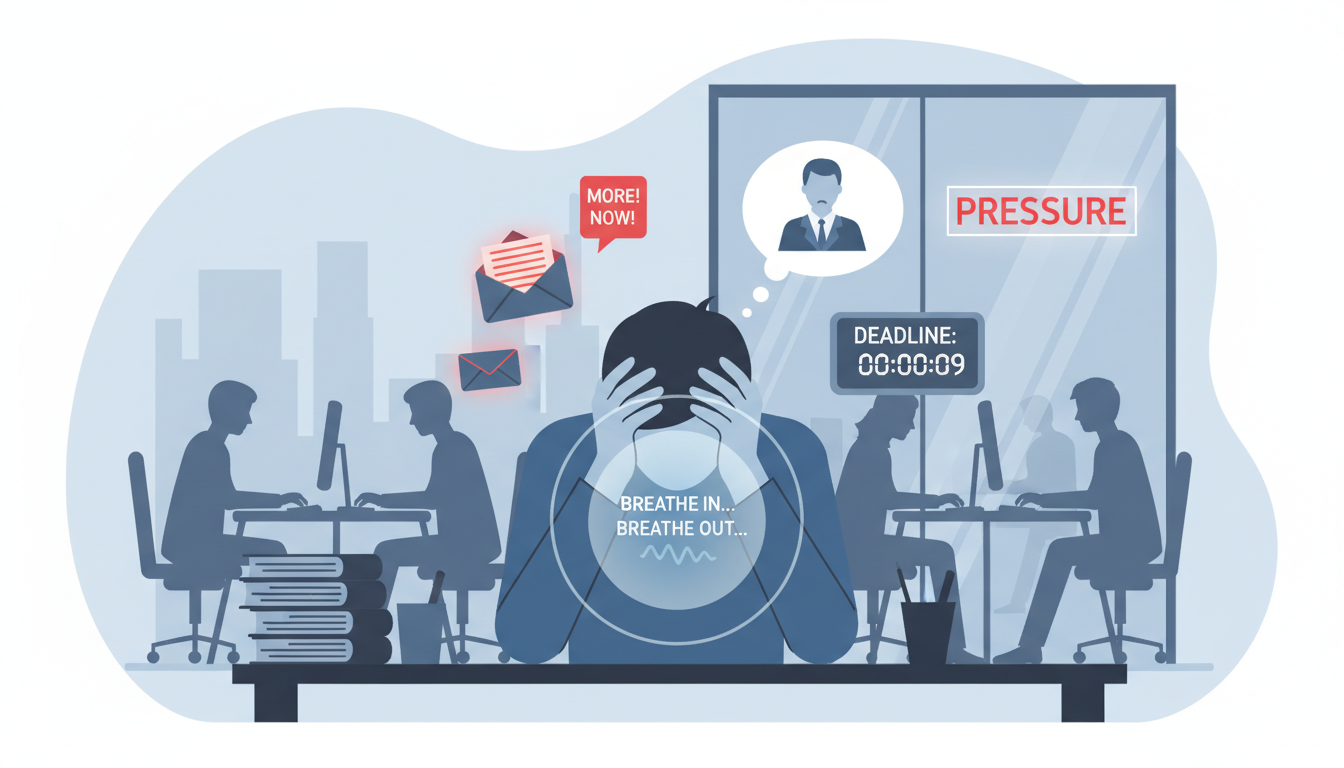
Performance Anxiety
Fear of making mistakes, not meeting expectations, or being judged on your work. This can lead to perfectionism, procrastination (due to fear of starting tasks), and excessive checking or reassurance-seeking.
Social Anxiety at Work
Difficulty with meetings, presentations, networking events, phone calls, or even casual conversations in the kitchen. You might avoid speaking up in meetings, eat lunch alone to avoid small talk, or feel physically unwell before presentations.
Email and Communication Anxiety
Spending disproportionate amounts of time composing emails, rereading messages for tone, or feeling anxious when you see unread messages. The always-on nature of modern communication can create a constant low-level anxiety about being contactable and responsive.
Imposter Syndrome
A persistent feeling that you are not qualified or capable enough for your role, and that it is only a matter of time before you are “found out.” Research suggests that up to 70% of people experience imposter syndrome at some point in their careers.
Physical Symptoms
Anxiety at work often manifests physically: stomach churning before the commute, headaches during the afternoon, chest tightness during meetings, or trembling hands when giving presentations.
Common Workplace Anxiety Triggers
- Excessive workload: Feeling overwhelmed by the volume or difficulty of work, particularly if deadlines are tight or resources are limited.
- Lack of control: Having little say over how you work, your schedule, or decisions that affect you.
- Poor management: Unclear expectations, inconsistent feedback, micromanagement, or lack of support from managers.
- Workplace relationships: Conflict with colleagues, bullying, or feeling excluded.
- Job insecurity: Fear of redundancy, restructuring, or contract non-renewal.
- Work-life imbalance: Long hours, inability to switch off, or work encroaching on personal time.
- Open-plan offices: Noise, lack of privacy, and constant visual stimulation can be particularly anxiety-provoking for some people.
- Change: Organisational restructures, new systems, new managers, or changes in role.
Your Legal Rights: Anxiety and the Equality Act 2010
In the UK, if anxiety substantially affects your ability to carry out normal day-to-day activities, it may be classified as a disability under the Equality Act 2010. This is the case even if you manage your symptoms with medication or coping strategies. If anxiety qualifies as a disability, your employer has a legal duty to make reasonable adjustments to support you.
What Are Reasonable Adjustments?
Reasonable adjustments are changes to your work environment or practices that help you perform your role. Examples include:
- Flexible working hours or the option to work from home
- A quieter workspace or access to a private room for breaks
- Advance notice of changes to routine or schedule
- Reduced exposure to specific triggers (e.g., being excused from large group presentations)
- Regular check-ins with a supportive manager
- Adjustments to performance targets during difficult periods
- Time off for medical appointments or therapy sessions
Your employer cannot treat you less favourably because of your anxiety, and you are protected from harassment and victimisation. For more information, the charity Mind publishes an excellent guide to workplace mental health rights, and ACAS (the Advisory, Conciliation and Arbitration Service) provides free advice on workplace issues.
Practical Strategies for Managing Anxiety at Work
Before Work
Morning routine: A calm, predictable morning routine can help set the tone for the day. Allow enough time so you are not rushing. Include something calming, whether that is a few minutes of mindfulness, a short walk, or simply sitting quietly with a cup of tea.
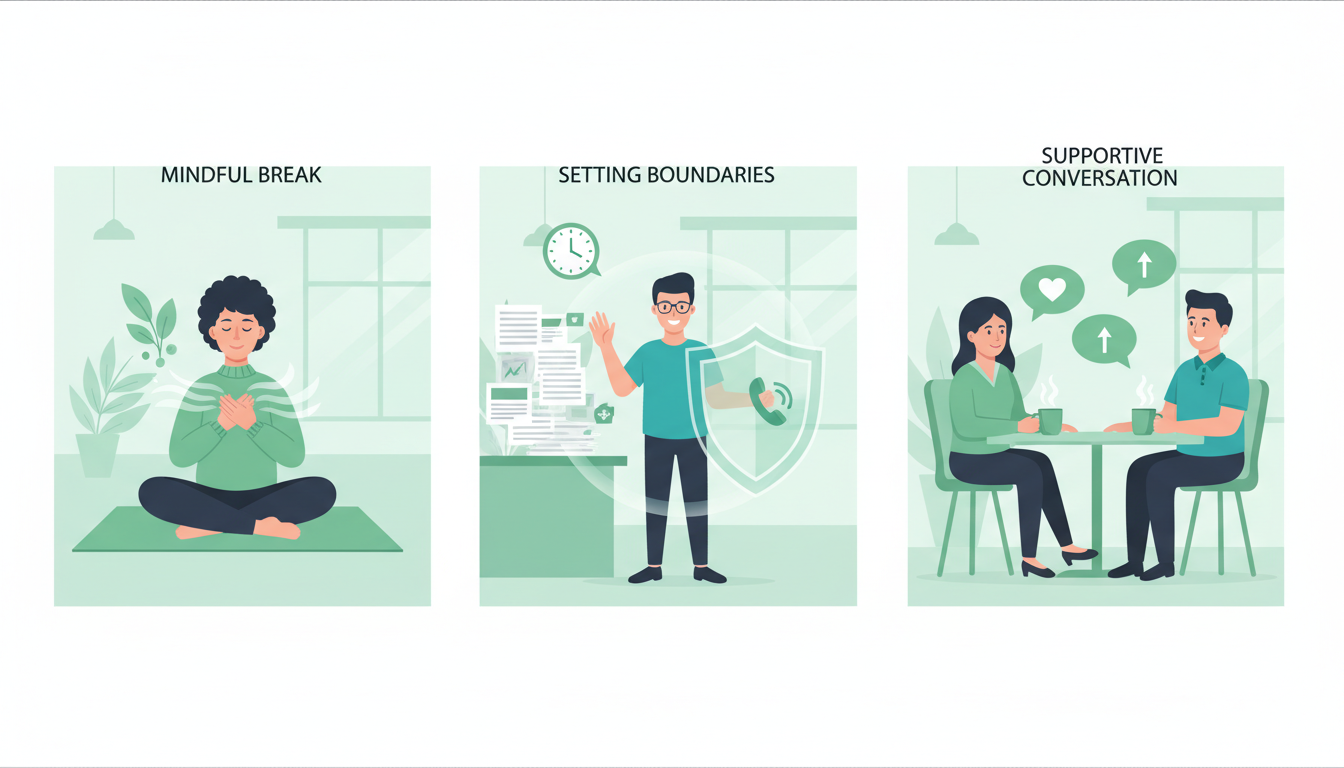
Prepare for known triggers: If you know you have a meeting or presentation that day, prepare as much as possible the evening before. Familiarity reduces anxiety, so rehearsing key points or reviewing the agenda can help.
During the Working Day
Break tasks into smaller steps: A large, overwhelming task becomes more manageable when broken into smaller, concrete steps. Focus on completing one step at a time rather than thinking about the whole project.
Use the two-minute rule: If a task will take less than two minutes, do it immediately. This prevents small tasks from accumulating into an anxiety-provoking backlog.
Set boundaries around communication: If constant emails or messages are a source of anxiety, try checking them at set intervals (e.g., every 90 minutes) rather than continuously. Most things can wait.
Take regular breaks: Even five minutes away from your desk can help reset your nervous system. Step outside for fresh air, stretch, or use a brief breathing exercise.
Breathing techniques at your desk: Box breathing (breathe in for 4 counts, hold for 4, out for 4, hold for 4) can be done discreetly at your desk before a meeting or phone call.
Manage perfectionism: Ask yourself: “Is this good enough?” rather than “Is this perfect?” Learning to submit work that meets the required standard rather than an impossibly high personal standard can significantly reduce anxiety and improve productivity.
After Work
Create a transition ritual: Establish a clear boundary between work and personal time. This might be changing clothes, going for a walk, listening to a podcast, or anything that signals to your brain that the working day is over.
Limit after-hours work: Resist the urge to check emails or continue working in the evening. If this is culturally expected in your workplace, it may be worth discussing boundaries with your manager.
Debrief with yourself: Spend a few minutes reflecting on what went well during the day rather than focusing exclusively on what caused anxiety. This practice can gradually shift your perspective.
Talking to Your Employer About Anxiety
Deciding whether to disclose anxiety to your employer is a personal decision, and there is no obligation to do so. However, if anxiety is affecting your work, opening a conversation can lead to helpful adjustments and support.
Tips for the Conversation
- Choose a time and setting where you will not be rushed or interrupted
- You do not need to share every detail; focus on what is relevant to your work
- Be specific about what would help (e.g., “It would help me to have more notice before changes to my schedule”)
- If you are not comfortable talking to your direct manager, you can approach HR, occupational health, or a mental health first aider if your organisation has one
- Keep a record of the conversation and any agreements made
Professional Support Options
Employee Assistance Programme (EAP): Many UK employers offer an EAP, which provides free, confidential counselling and support. Check with your HR department.
NHS Talking Therapies: Free CBT and other talking therapies for anxiety. You can self-refer in most areas of England without needing a GP appointment.
Your GP: Can discuss medication options, provide sick notes if needed, and refer to specialist services.
Occupational health: If your employer has an occupational health service, they can provide a professional assessment and recommend adjustments.
UK Resources
- Mind: Workplace mental health resources and information. Infoline: 0300 123 3393.
- Anxiety UK: Helpline: 03444 775 774.
- ACAS: Free advice on workplace rights and disputes. Helpline: 0300 123 1100.
- HSE: Information on employer duties regarding work-related stress. Website: hse.gov.uk.
- Mental Health at Work: A gateway to resources for employees and employers. Website: mentalhealthatwork.org.uk.
Conclusion
Workplace anxiety is an incredibly common experience, and it is not something you need to simply endure. With the right combination of practical strategies, professional support, and, where appropriate, workplace adjustments, it is possible to manage anxiety effectively while maintaining a fulfilling career. Remember that anxiety is a health condition, not a character flaw, and you are entitled to support. Whether you start with a self-help technique, a conversation with your GP, or a call to a helpline, taking the first step is what matters most.
Frequently Asked Questions
What Does Workplace Anxiety Look Like?
Workplace anxiety can present differently from person to person, but common manifestations include:
What Are Reasonable Adjustments?
Reasonable adjustments are changes to your work environment or practices that help you perform your role. Examples include:
How does anxiety at work affect daily routine?
For Anxiety at Work, this question is best answered with personalised guidance. If you are concerned, speak to your GP or contact NHS 111. The article above outlines the most relevant evidence-based approaches.
Related Articles

Relationship Anxiety: Signs, Causes and How to Cope
Relationship anxiety can affect even the healthiest partnerships. Learn the signs, causes, and evidence-based strategies to cope with anxiety in relationships.

Anxiety in Social Situations: Practical Coping Strategies
Social situations can trigger anxiety for many people. Find practical coping strategies to face social anxiety with more confidence.
High-Functioning Anxiety: Signs, Causes and How to Cope
High-functioning anxiety hides behind success and a calm exterior. Learn the signs, why it happens, and gentle, evidence-based ways to cope and recover.